Present Dangers by Robert Kagan
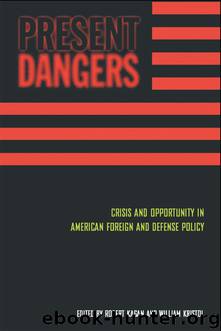
Author:Robert Kagan [Kagan, Robert; Kristol, William]
Language: eng
Format: epub, mobi
ISBN: 9781594033391
Publisher: Encounter Books
The Question of China
What reasons are there for thinking that China might, in fact, make a bid for regional dominance? Although in the modern world size does not translate automatically into useable power, the magnitude of China’s population and landmass increases its plausibility as a potential regional hegemon. China comprises 68 percent of East Asia’s territory, not including India or Russia, and 65 percent of its population. “The only other region in the world where the balance of power is so dominated by a single state,” writes Gerald Segal, “is North America.”1
By some estimates, China’s total economic output may already be approaching Japan’s, and if it continues to grow at a rapid rate, it could exceed that of the United States by the middle decades of the next century. Because of its enormous population, China would still be a relatively poor country, but it would nevertheless have more resources than it does today to devote to its foreign policy goals, while at the same time raising the living standard of its people. Because power is, in part, a matter of perception, a China whose economy was the largest in Asia, and maybe in the world, would be more likely to inspire awe, and perhaps fear, in its neighbors.
It is worth noting that every modern great power has gone through a period of rapid internal growth combined with increased external assertiveness. As Samuel Huntington notes,
Every other major power, Britain and France, Germany and Japan, the United States and the Soviet Union, has engaged in outward expansion, assertion, and imperialism coincidental with or immediately following the years in which it went through rapid industrialization and economic growth. No reason exists to think that the acquisition of economic and military power will not have comparable effects in China.2
Fast-rising powers tend to be disruptive of existing international order, in large part because they are reluctant to accept the institutional constraints, border divisions, and hierarchies of political prestige established when they were relatively weak. Emerging powers often seek to change, and sometimes to overthrow, the status quo, and to establish new arrangements that more accurately reflect their new conception of themselves and of their preferred role in the world. Thus, in the second half of the nineteenth century and the first years of the twentieth, imperial Germany risked war to gain its “place in the sun.” A century earlier, the United States, having achieved independence, declared its intention to extrude the European powers from the Western Hemisphere. At the time of the promulgation of the Monroe Doctrine, most Americans simply took it for granted that their country should be dominant in “its” region.
In addition, several factors unique to China may tend to reinforce this basic correlation between growth and assertiveness. There is, first of all, Chinese history. One hundred years of humiliation at the hands of European imperialists may have left the Chinese people with a lasting sense of vulnerability, sensitivity, and resentment towards outside oppressors; it has certainly left the Chinese government with a long list of as-yet-unresolved territorial claims against many of its immediate neighbors.
Download
This site does not store any files on its server. We only index and link to content provided by other sites. Please contact the content providers to delete copyright contents if any and email us, we'll remove relevant links or contents immediately.
| Anthropology | Archaeology |
| Philosophy | Politics & Government |
| Social Sciences | Sociology |
| Women's Studies |
The Secret History by Donna Tartt(19443)
The Social Justice Warrior Handbook by Lisa De Pasquale(12286)
Thirteen Reasons Why by Jay Asher(9106)
This Is How You Lose Her by Junot Diaz(7044)
Weapons of Math Destruction by Cathy O'Neil(6455)
Zero to One by Peter Thiel(5930)
Beartown by Fredrik Backman(5915)
The Myth of the Strong Leader by Archie Brown(5619)
The Fire Next Time by James Baldwin(5573)
How Democracies Die by Steven Levitsky & Daniel Ziblatt(5318)
Promise Me, Dad by Joe Biden(5225)
Stone's Rules by Roger Stone(5181)
A Higher Loyalty: Truth, Lies, and Leadership by James Comey(5075)
100 Deadly Skills by Clint Emerson(5016)
Rise and Kill First by Ronen Bergman(4886)
Secrecy World by Jake Bernstein(4861)
The David Icke Guide to the Global Conspiracy (and how to end it) by David Icke(4837)
The Doomsday Machine by Daniel Ellsberg(4608)
The Farm by Tom Rob Smith(4591)
